Explorations Into Alternative History
with Natasha Rendell
Howard Carter’s unearthing of Tutankhamun’s treasure-laden tomb set a seemingly impossible task for archaeologists, as they try to emulate the huge impact he made. Time and again, we hear of their discoveries as they search for a magnificent discovery that will also ensure their own place in the history books.
Unfortunately, unlike Tutankhamun’s tomb, undisputed evidence is very rarely found. Take, for instance, when Joann Fletcher in 2002 announced to the world that she may have found the elusive Queen Nefertiti. She had been investigating three mummies in Tomb KV35, which had been found in 1898. They appeared to be two women and a young boy. One of the women had a double-pierced earlobe, indicating a high-status person, a royal woman. Jewellery was found in the smashed-in chest cavity, and the right arm, which had been ripped off, was bent as if its fingers were still holding a royal sceptre.
Joann Fletcher surmised that this mummy was quite possibly that of Nefertiti, however her conclusion was dismissed by a prominent group of Egyptologists. They considered the evidence to be insufficient, circumstantial and inconclusive. Others even declared her claim to be balderdash, and subsequently she was banned from working in Egypt until 2008. She had broken the rule that all prominent discoveries were subject to approval by the Supreme Council of Antiquities prior to publication in popular media.
Was this Nefertiti or some other high-status woman? This will probably never be known, as there were no objects entombed with these mummies that indicated who they actually were.
There is also a theory that behind a wall in Tutankhamun’s tomb, there is a hidden chamber in which Nefertiti could be found. Perhaps there is indeed more to be found, seeing how the chamber is so small and obviously was constructed for someone other than the boy king. Apparently, when traversing to the place of burial, his tomb takes a right turn, whereas tombs for males should take a left. This adds weight to the theory that his tomb was originally intended for a woman. Also, on his famous death mask, the face was made of a different gold before being welded on. And not only that, it had pierced ears, something back then reserved for women, and it was originally inscribed with Nefertiti’s throne name Ankhkheperure before being altered to Nebkheperure, Tutankhamun’s throne name. Also found in this tomb were canopic jars and statues that clearly have female features, along with linen wrappings that carried Nefertiti’s name and many other items that with different names.
As for the possibility of a hidden chamber, it will probably remain a mystery. With recent scans disputing its existence, it is unlikely that even a small portion of the decorated walls will be dismantled.
So perhaps Nefertiti or even Cleopatra, Alexander the Great and many other figures of history have already been found and merely relegated to the basement of a museum because of the lack of named burial finery.
In Romania, in the village of Mizil, just 140 miles from the Black Sea, during a highway construction, workers found the tomb of a Hun warrior. This site revealed a magnificent burial with grave goods and the fully intact remains of an elite warrior dating back to the 5th century AD. The face of the complete skeleton was covered with a gold mask. Found were more than one hundred artefacts along with the warrior’s horse and its gilded saddle. The weapons buried with him included an iron sword with a gilded scabbard, a dagger with a gold-covered hilt inlaid with different types of gemstones, bundles of iron arrowheads and decorated braces of bone, perhaps part of a wooden bow.
Also found was a bronze cauldron, many pieces of gold jewellery and decorated wall-mounted candle settings. The style of the weapons and jewellery linked the burial to the 5th century AD, and because of the priceless nature of the goods, it was clear that he belonged to the region’s ruling class and thus a prince.
This may even be the burial place of Attila the Hun, who died in 453AD, as despite extensive searches he has never been found. It seems that this actually might be him but it will never be known because the tomb lacks any named burial finery. It would have never been thought necessary as the possibility of the grave being disturbed was unthinkable.
Just as the city of Troy, from Homer’s epic works, was dismissed and passed by as the excavation continued on downwards to another settlement that suited the archaeologist, how many people and places have actually been unearthed but ignored? Surely an open mind and even an imagination are of great importance when formulating theories or uncovering the past. Indeed, everything is worthy of consideration. Nothing should be dismissed as ridiculous just because it does not suit the narrative of accepted history.
The recording of our history, our past, should be fluid, changeable, able to be challenged with no limitation of set minds that claim they know the truth and anything else is mere speculation and rubbish.
Instead, surely it would be better to simply say that what has been discovered is their interpretation, their theory. This would leave the way open for the possibility of new discoveries that will enrich and add to the fascinating saga of humankind.
Author: Natasha Rendell

Natasha’s upcoming novel Imagining Nefertiti is out 22 March 2026. She is the author of Imagining Jesus and co-author of Wisdom’s Fragrance.
PRE-ORDER NOW
Join Our Newsletter to get our latest articles, special offers, and updates on upcoming pre-orders and new releases.
Share this post
Blog Text: Copyright © Natasha Rendell 2025, All Rights Reserved.
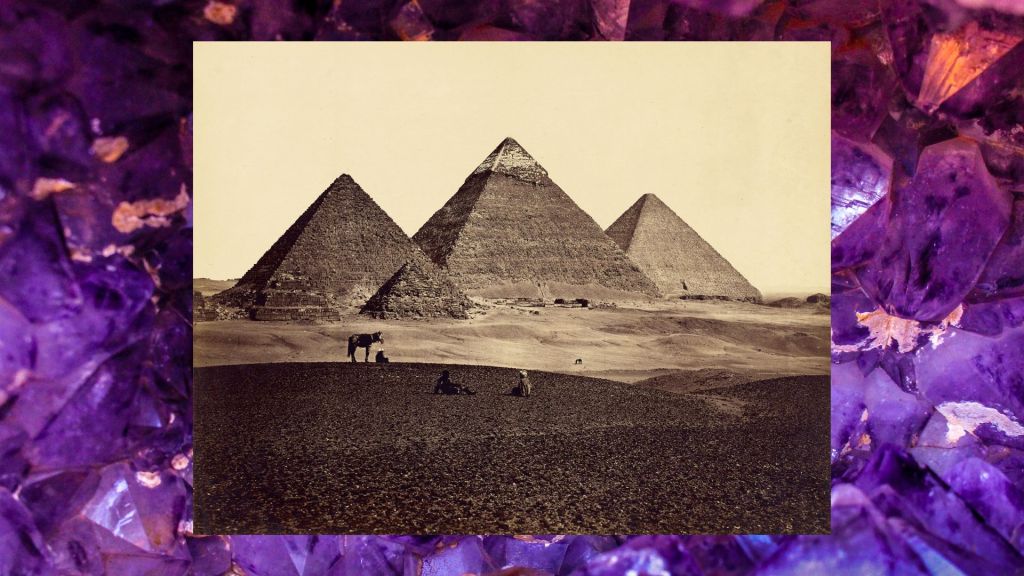
Image Credits: The Pyramids of Giza from the Southwest by Francis Frith public domain image from Getty Museum
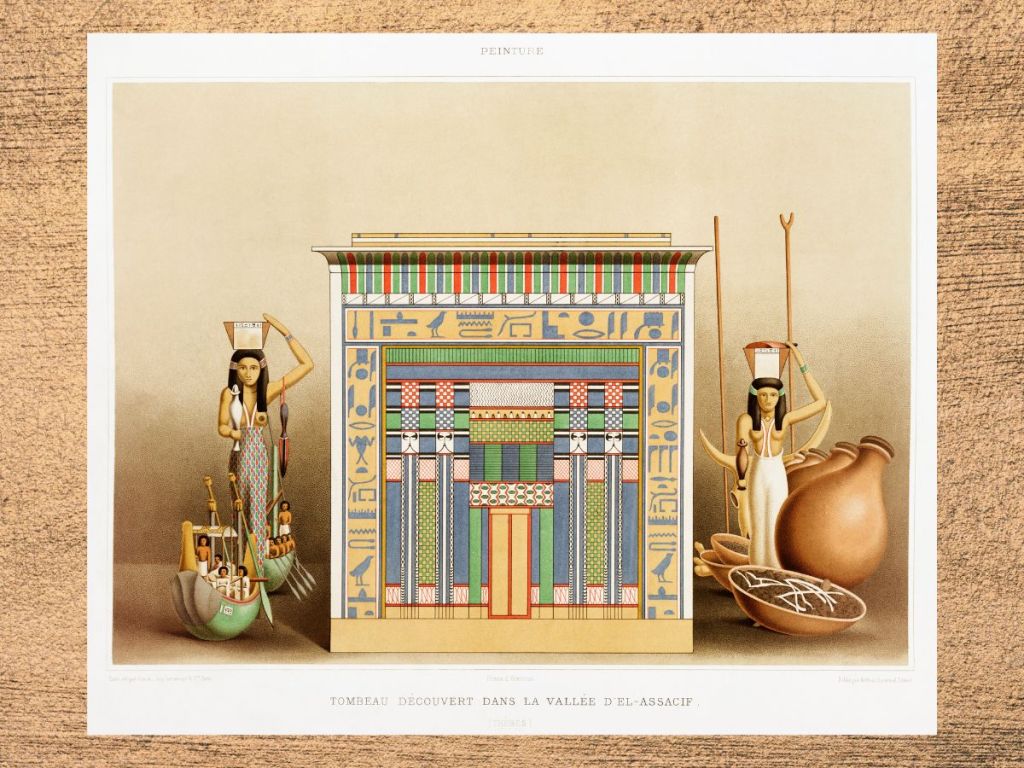
Discovered tomb in Valley of El-Assacif from Histoire de l’art égyptien (1878) by Émile Prisse d’Avennes

Leave a comment